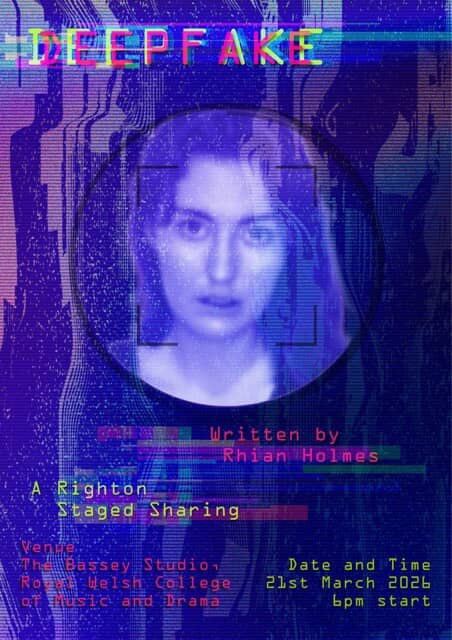
If you have been following our blog for a little while, you will be aware that before Christmas we chatted to the amazing—and our previous tap dancing partner—Rhian Holmes (which you can watch here: https://youtu.be/NkOz39fu7E0). During that conversation, they hinted that they would soon be bringing a brand new production to Cardiff, and we are excited to announce that DeepFake has finally arrived at the Royal Welsh College of Music and Drama. This show tells the story of a group of teenagers dealing with the influx of technological advancements, and in particular the dangers of Artificial Intelligence. A video has been created of a teacher in an intimate act, which triggers a series of safeguarding protocols and results in the teacher themselves being put on leave while the school investigates.
As this production was a staged reading/work-in-progress performance, the actors had their scripts in hand throughout, and the entire production was fairly stripped back in terms of staging, lighting, and other technical elements. However, this allowed the characters, themes, and emotional stakes to really shine through, enabling the audience to truly connect with and relate to almost every character.
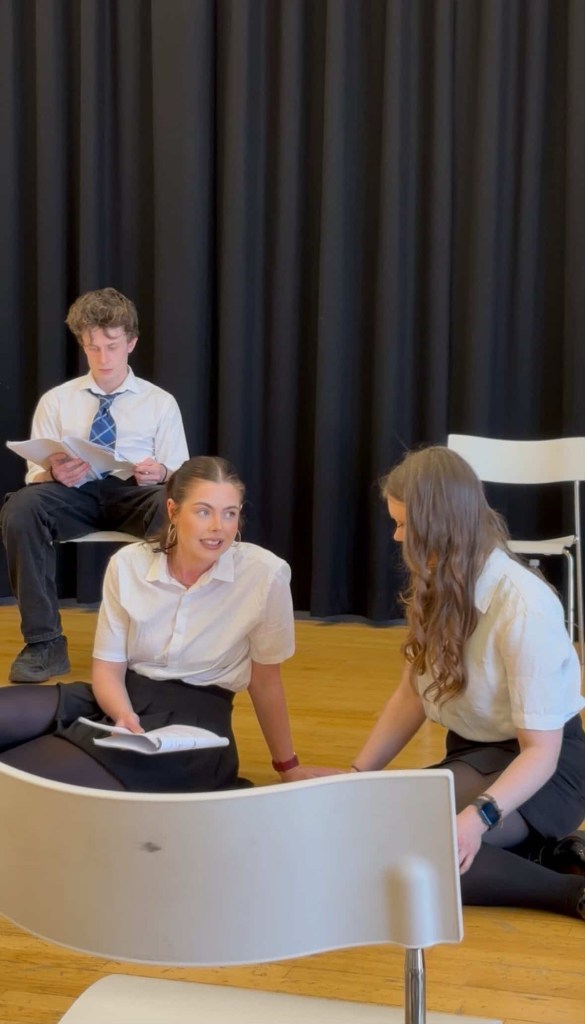
The entire show is built upon an almost “whodunnit”-style narrative, as the staff and pupils attempt to figure out who created the AI video. In the early stages of the play, the audience is led to believe that this was the work of the troublesome class clown, Harvey (captured brilliantly by Cameron Davies), as he has constant friction with the victim, Mrs Priestly, due to being repeatedly reprimanded for his behaviour in her class. Cameron perfectly portrays this attention-seeking role, delivering an incredibly theatrical and over-the-top performance that paints the character in a very specific light from the opening of the show. This portrayal is so wonderfully physical and exaggerated that it almost leans into classical clowning tropes—something I personally feel Cameron is completely at home with. My favourite scene of the production saw the class ensemble together as Harvey delivered a series of rude gestures and strong language directly to the audience, thereby including them in the action and adding a sense of immersiveness. This resulted in fits of laughter from everyone in attendance. This behaviour is then further disciplined by the cover teacher, Mr Cross (portrayed by Thomas Carruthers), suggesting that Harvey is capable of tormenting teachers beyond the classroom.
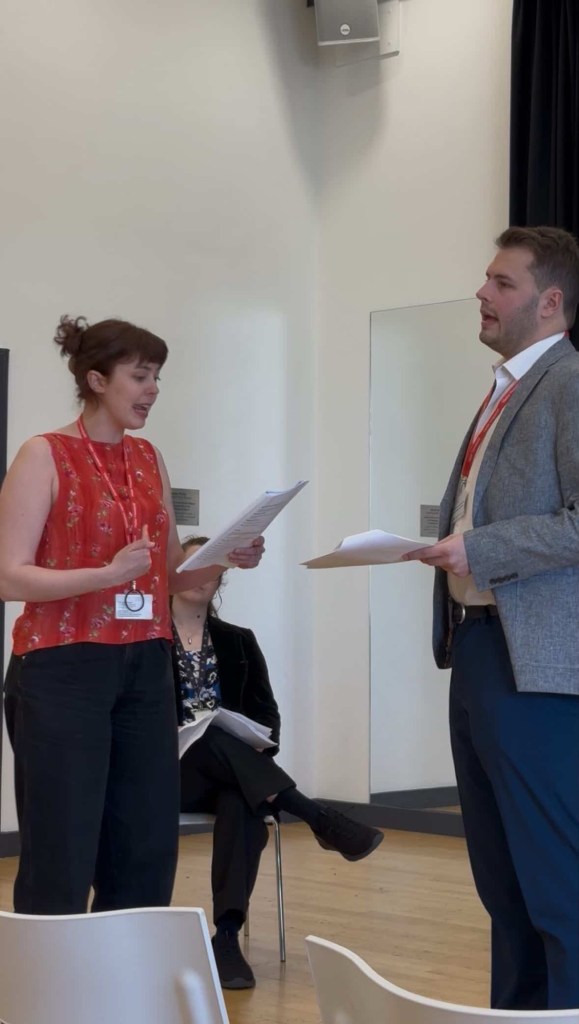
The opening scene of the production sees Mrs Priestly (portrayed by Ruby Wilde) attending a meeting with her line manager and headteacher, Mrs Geoff (played by Morwenna Brown), as they discuss the incident and establish the central narrative. Mrs Geoff carries an air of authority and professionalism every time she steps onto the stage, perfectly suiting the role. However, while she convincingly embodies the responsibility of running a school, the character is also presented as someone who is somewhat oblivious to modern technological advancements—particularly AI. This leads to a number of hilarious moments, as she struggles with her mobile phone and asks what many might consider obvious questions about whether the video is real and how it was created. This not only makes the character relatable to audiences less familiar with technology but also injects a welcome sense of humour into an otherwise serious and unsettling narrative.
My favourite character in the production, however, was Flick (played by Mollie Monkton), a rough-around-the-edges student who becomes drawn into the world of technology as a means of improving her financial situation. This character feels highly relatable, as most people will recognise someone like Flick, regardless of their background—a testament to how honestly Mollie portrays the role. After working in a café for some time, Flick discovers a website where users can sell pictures of their feet, and as the money begins to come in, she becomes increasingly drawn to this line of work. This subplot highlights other aspects of technology that young people may encounter, while also exposing deeper institutional issues within the school—revelations that prompted audible gasps from the audience.
Alongside the headstrong Flick is the incredibly innocent Jenna (brought to life by Jessica Hammer), who, I must admit, reminded me very much of myself at school. She is academically focused and driven, but her friendship with Flick allows her to see a different perspective. Their relationship is a fantastic portrayal of school friendships: complete opposites who spend time together doing very little, fall out dramatically, and inevitably reconcile. Their dynamic works beautifully, and Jenna plays a key role in the shocking reveal towards the end of the show, which ultimately strengthens the bond between the two friends.
In conclusion, DeepFake, created by Rhian Holmes in association with Righton Productions and the Royal Welsh College of Music and Drama, is a highly important and deeply relatable exploration of the dangers of AI and how young people are navigating these rapidly evolving technologies. As a school teacher myself, I can say that this is an issue that is becoming increasingly prevalent, making work like this more vital than ever. Even as a staged reading, it is easy to see the scale and potential of this production, and where more technical and design elements could be developed in the future. I, for one, cannot wait to see where this piece goes next. I would rate this production 4 out of 5 stars.

 Rhysreviews